 snuup
How do I get my new business on ChatGPT?
Updated 3 November 2026

ChatGPT cannot know a business that opened after its training data was gathered, so a new business shows up only when ChatGPT searches the web for the answer. There is no form to fill in and no listing to claim inside ChatGPT. You get in by being findable: let OpenAI's search crawler into your website, say plainly on it what you do and where, and get your name onto the sites ChatGPT reads, starting with your Google and Bing listings. Plan on weeks, not days.
Why ChatGPT has never heard of you
 ChatGPT, from memory
Tell me about Kingfisher Barbers in Port Ellery.
I don't have any information about a barbershop called Kingfisher Barbers in Port Ellery. It may be new or very small.
ChatGPT, searching the webTell me about Kingfisher Barbers in Port Ellery.
Kingfisher Barbers is a barbershop on Quay Road that opened this year. Its website lists skin fades, beard trims and kids' cuts, and it is open on Sundays.
ChatGPT answers in two ways. From memory, it uses what it learned from text gathered before a cutoff date, months or years ago. A shop that opened this spring is not in there, however good it is.
The other way is a web search. OpenAI's help page on searching the web says ChatGPT may search automatically when a question would benefit from current information, and that it can use the asker's rough location to find local results. That search is the only door a new business has, and everything in this guide is about getting through it.
So the job is not to teach ChatGPT about you. It is to be easy to find, on your own website and on the sites a search turns up, at the moment a buyer asks.
Check it: ask ChatGPT "Tell me about [your business] in [your town]". Then ask again with Search switched on from the tools menu. If the first answer knows nothing and the second finds you, your website is reachable. If neither finds you, start with the next step.
Step 1: Let ChatGPT's search into your website
kingfisherbarbers.com/robots.txt
OAI-SearchBot may read the site
Puts you in ChatGPT's search answers
Firewall lets OpenAI's crawler through
Some hosts block unknown bots
Site builder's "hide from search" is off
Often left on from the launch
OpenAI says it plainly on the same help page: to be eligible for ChatGPT's search results, allow OAI-SearchBot to crawl your site and make sure your host or content delivery network lets OpenAI's crawler through. Placement is not guaranteed, but a site that turns the crawler away cannot be found at all.
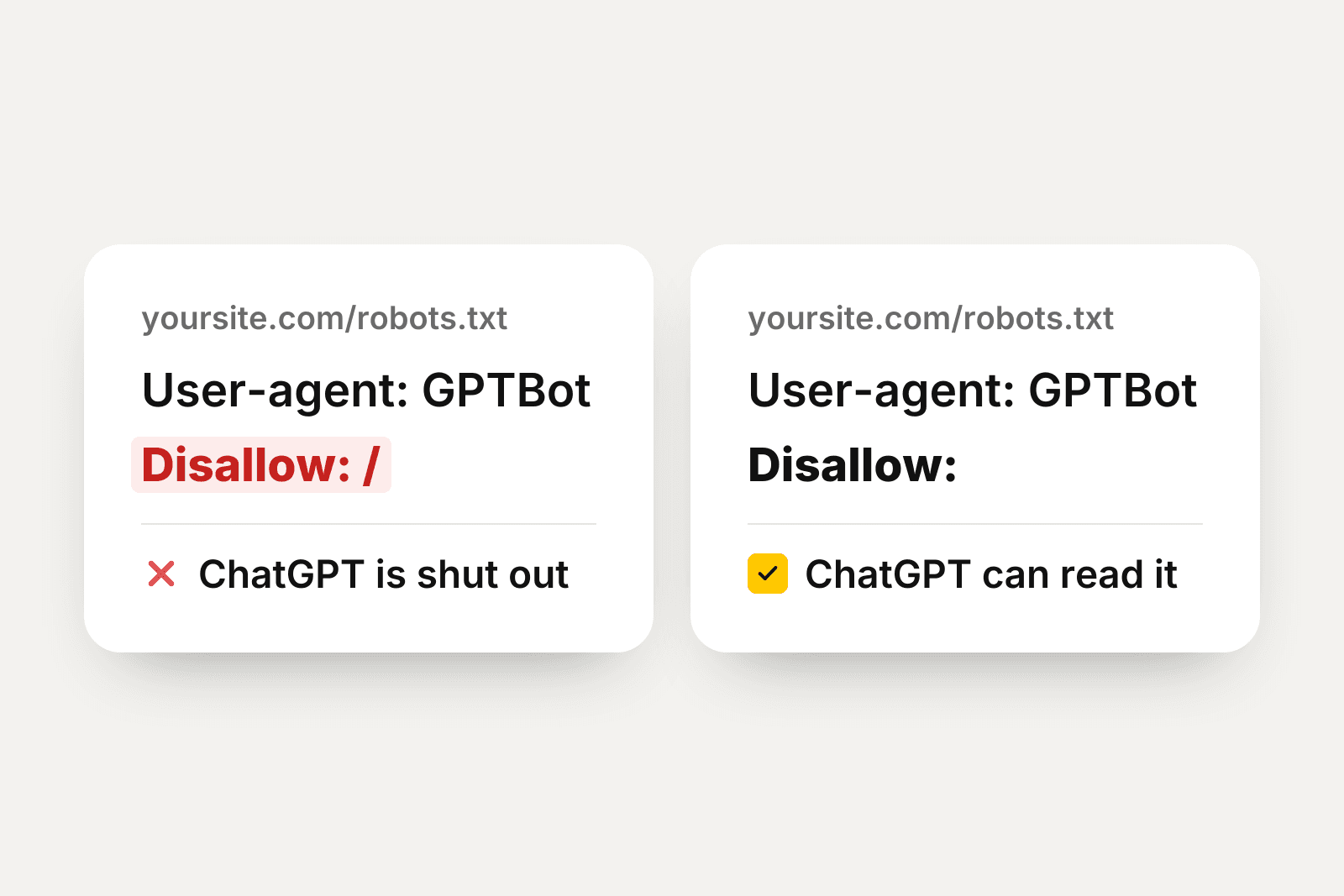
OpenAI's crawler page explains the two names you will see. OAI-SearchBot finds pages for ChatGPT's search answers. GPTBot gathers text for training. You can block GPTBot and still allow OAI-SearchBot, and OpenAI says a robots.txt change takes about 24 hours to reach its search.
New sites trip on this more than old ones. Site builders often keep a "hide from search" setting on while you build, and it is easy to forget at launch. Here is how to check whether your website blocks ChatGPT, line by line.
Check it: open yoursite.com/robots.txt, with your own domain. Look for OAI-SearchBot, or for "User-agent: *" followed by "Disallow: /". Either one with a Disallow under it keeps ChatGPT's search out.
Step 2: Get into the search indexes ChatGPT draws on
site:kingfisherbarbers.com
4 of 5 pages found
Bing
0 of 5 pages found
Six weeks after the site went live.
ChatGPT does not search the whole web by itself. Its help page says it sometimes partners with other search providers and sends them a rewritten version of the question, and the providers it links are Microsoft and Shopify. Bing is Microsoft's search. A new site that Bing has not found yet is easy to miss.
Tell Bing you exist. Bing Webmaster Tools is free: add your site, prove you own it and send your sitemap. On WordPress, Bing's own plugin sends new pages to it as you publish them.
Do the same for Google with Search Console. ChatGPT is not the only AI your buyers use, and Gemini and Google's AI Overviews come from Google's index. Google's guide says crawling can take a few days to a few weeks, and asking again for the same page does not speed it up.
Check it: search site:yourdomain.com on bing.com and on google.com. Count the pages each one shows against the pages your site has.
Step 3: Say what you do in your first lines
Look sharp. Feel sharp.
Book now
Barbershop on Quay Road, Port Ellery
Skin fades, beard trims and kids' cuts. Walk-ins welcome, open Sundays.
When a search does land on your site, the answer is built from what your pages say, in words. A slogan tells it nothing. The first lines of your homepage should say what you are, where you are, and the things buyers ask for by name.
Give each main service its own page or its own heading, put your address and opening hours in text rather than in a picture, and use the words buyers use. If people ask for a "skin fade", write skin fade, not "precision styling".
Check it: read the first two lines of your homepage to someone who has never heard of you. If they cannot say what you sell and in which town, AI cannot either.
Step 4: Get your first mentions on other sites
Kingfisher Barbers's first mentions
- Google Business Profile, verified✓
- Bing Places listing✓
- "New in town" piece in the Port Ellery Gazette✓
- Port Ellery business directory✕
- Best barbers in Port Ellery list✕
- Ten reviews that say what the cut was✕
Your own website says what you do. Other sites say you are real and worth recommending, and for local questions ChatGPT leans on them. OpenAI's help page says it may share a rough location with third-party providers that supply nearby business listings. It does not name them, so cover the big listings.
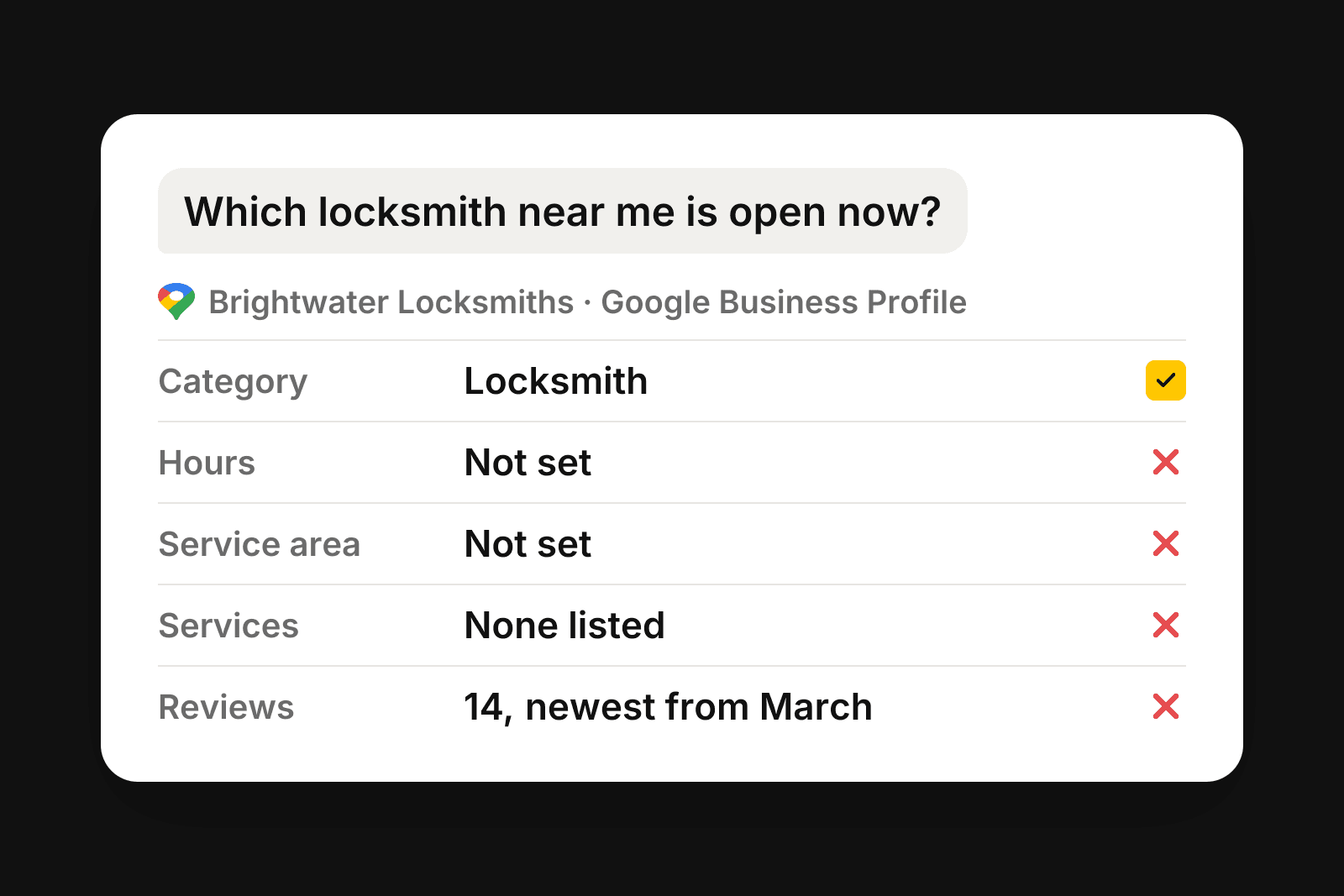
Start with a Google Business Profile and get it verified, then Bing's own listing, Bing Places. Use the same name, address and phone number everywhere. What a Google Business Profile does for AI answers is its own guide.
Then the places a new business can reach in its first months: your town's business directory or chamber of commerce, your trade's directories, a "new in town" piece in the local paper, and the "best of" lists for your trade and town. Ask your first customers for reviews that say what you did for them.
Check it: ask ChatGPT the question your buyers ask, with your town in it and your name left out. Open Sources under the answer and write down every site it read. That list is where to be.
Win the narrow questions first
ChatGPTWho's the best barber in Port Ellery?
Hollis Street Barbers has been around for years and has hundreds of reviews. Fadehouse is known for fades and gets mentioned in local lists.
ChatGPTIs there a barber open on Sunday in Port Ellery that does kids' cuts?
Kingfisher Barbers on Quay Road is open on Sundays and lists kids' cuts on its website.
A new name rarely beats the shop with ten years of reviews on the broad question. "Who's the best barber in town?" goes to the businesses most of the web already talks about.
The narrow questions are different. Opening hours, a service the others don't offer, a part of town, a kind of customer: when the question is that specific, the answer goes to whoever says it clearly, and few rivals bother. Write down the five most specific things you do and make sure each one is written on your site and in your listings.
The broad questions come later, as reviews and mentions pile up. How to get ChatGPT to recommend your business covers that longer road.
Check it: ask ChatGPT three questions that only your business answers well, with your town in each. Note which ones name you today and check again in a month.
See where your new business stands
snuup asks ChatGPT, Claude, Gemini and Perplexity the questions your buyers ask and shows you every answer: whether you are named and who is named instead. It also asks ChatGPT about your business by name and tells you when it doesn't know you.
For a new business the problems it finds are often the basics: a website that turns AI crawlers away, a site Google has not found yet, or, for a local business, no listing buyers can find on Google Maps. Each one comes with what to do about it. On the paid plan we make the fixes for you and ask AI again every month, so you see the month your name first shows up.